Research Studio 2026
April 2, 2026: The annual Arboretum Research Studio furthers the Arboretum’s mission to conserve biodiversity and connect people to nature through research, teaching and campus and community engagement. Over the afternoon, presentations covered a variety of topics from students, faculty,and staff from a variety of disciplines representing five colleges across the University of Guelph community.
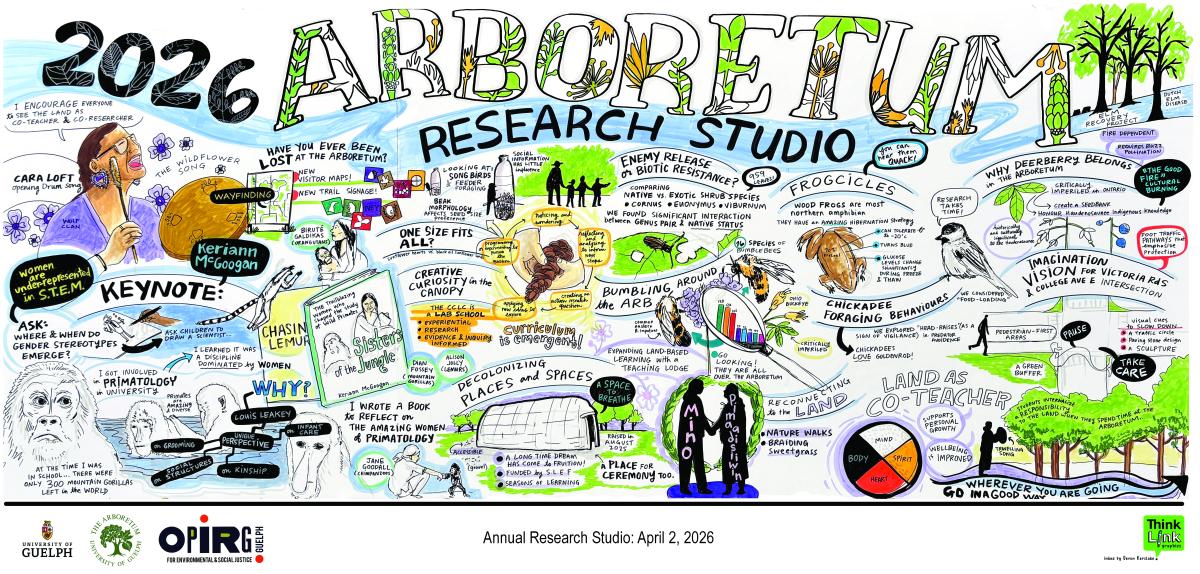
Keynote Presentation
UofG staff member Keriann McGoogan gave a captivating presentation about her experiences researching primates in Belize and Madagascar as our Keynote Speaker for this year's Research Studio. Keriann talked about her research, career path, and her newest book Sisters of the Jungle: The Trailblazing Women Who Shaped the Study of Primates, which explores the history of primate research and the contributions of many women who broke boundaries on thier way to developing this field of science, including Jane Goodall, Dian Fossey, Birutė Galdikas and others.
Keriann McGoogan is the College Research Manager, Ontario Veterinary College and an author & writer with work appearing in The Globe and Mail, The Walrus, Orion, Outpost Magazine, the Toronto Star, and as part of the anthology Bad Artist: Creating in a Productivity Obsessed World (Touchwood Editions, 2024). In 2021, McGoogan was selected as a Writers’ Trust Rising Star.
Research Presentations
| Title of Presentation | Presenter (s) | Affiliation | Project Description | Link to Video |
|---|---|---|---|---|
| Arboretum Wayfinding | Alison Morrison | The University of Guelph Arboretum | https://youtu.be/UxSX9Oilq84 | |
| One Size Feeds All? How Beak Size Affects Seed Preference in Songbirds at Feeders | Helaena Harwart, Finn Gerulath, Aisha Chademanah | College of Biological Sciences, ZOO*4070 | These students from the Fall '25 ZOO*4070 - Animal Behaviour course, chose for their group research project to examine whether songbirds of different beak sizes differed in preference of seed size. The observational experiment for this project was conducted near pre-established feeders in the Arboretum. This presentation will cover some of the background and findings of their research. | https://youtu.be/cz647SvB2fo |
| Creative Curiosity in the Canopy: Co-creating Curriculum with Children through Action Research | Valerie Trew and Kim Barton | University of Guelph Child Care and Learning Centre | https://youtu.be/Gc8F2Q8Ak_I | |
| Enemy Release or Biotic Resistance: Patterns of Foliar Herbivory between Native and Exotic Shrub Species | Maija Ranta, Ada Acker, Jakob Ducharme, John Dabu | College of Biological Science, BIOL*3010 | The goal of our study was to determine the extent of foliar damage by insect herbivores to genera pairs of native and exotic shrub species in the Arboretum, and whether these patterns support the Enemy Release Hypothesis or the Biotic Resistance Hypothesis. We examined three pairs of native and exotic shrub species in the Cornus, Euonymus, and Viburnum genera and sampled their leaves to determine the extent of foliar damage to each species. | |
| Bumbling Around the Arb | Parker Smale, Col Blair, Annika Wilcox | Wildlife Preservation Canada | Wildlife Preservation Canada, a wildlife conservation organization based out of Guelph, has been surveying bumble bee populations across Ontario for 12 years. Let's take a look at what we've found at the Arboretum in that time! | https://youtu.be/v29c2PLPz5o |
| Decolonizing Places and Spaces: Expanding Land-Based Learning with a Teaching Lodge | Sarina Perchak, Cara Wehkamp, Cara Loft | U of G, Office of Indigenous Initiatives and U of G, Office of Teaching and Learning | Presenters will share their experiences over the last year acquiring, raising, and using a Teaching Lodge in the University of Guelph Arboretum at the Nokom’s House Research Centre (NHRC) site. They will speak to the importance of a Teaching Lodge for improved Land-based learning and research opportunities and cultural connection. As well as the capacity of the Teaching Lodge to be a space of Decolonization, Indigenization and Reconciliation (DIR) at the University of Guelph. | https://youtu.be/o-awNbMtPkc |
| Reconnecting to the land: A study to explore wellness of Indigenous students at the University of Guelph | Marah Laforge and Lauren Sneyd | Ontario Agriculture College, IES*4010 | This presentation is on a 4th year research project taking place in the Arboretum as part of the 4th year Bachelor of Indigenous Environmental Science and Practice (BIESP) courses. The project I have developed since September aims to understand what mino pimaadisiiwin (living the good life) means to Indigenous students on campus. I aim to explore their perspective on this wellness concept and others shared with me to understand how students view their connection to the environment. As part of my methodology, I am conducting nature walks, sweetgrass braiding ceremony, and photovoice to inform my data collection process. | https://youtu.be/5NxBfNrlia4 |
| Frogcicles: How wood frogs (Lithobates sylvaticus) survive Canadian winters | Amanda Reside | Ontario Agriculture College and the College of Biological Sciences |
We are studying the hibernation strategy of wood frogs, who can survive extreme freezing conditions. In subzero temperatures, the wood frog's whole body freezes solid, then thaws, and the frog goes right back to hopping around and catching crickets. This presentation showcases the physiology behind this amazing feat of evolution. |
https://youtu.be/ut79FOv1Ksc |
| Examining energy optimization and predation risk in black-capped chickadees | Lillian Giroux, Caitlyn Correia, Alec Brazeau, Kaitlyn Cline, Nikki Legault | College of Biological Science, BIOL*3010 | Our group set up homemade birdfeeders one-at-a-time in the arboretum at two distances from the forest edge. We played chickadee calls to draw-in the resident flock and observed their feeding behaviour -- both time spent at the feeder, and number of head raises per visit to the feeder -- to help answer the question of why and how chickadees choose their feeding sites. The presentation includes and introduction into our project, a summary of our statistical analyses and outcomes, and what we learned from our hands-on research experience. | https://youtu.be/T6wMGD2cfjI |
| Why Deerberry Belongs in the Arboretum | Colton Falkenberg | Ontario Agriculture College, ENVS*2700 | This presentation was originally an assigned project for the new Trees and Conservation course held in the Arboretum. The presentation highlights how the addition of a new species, the Deer Berry, would benefit the arboretums ecology, teaching and research objectives. | https://youtu.be/w_UCHOnQSac |
| Imagination Vision for Victoria Rd S and College Ave E ntersection | Steven Clarke, Elmira Fetrati, and Alex Cogswell | Ontario Agriculture College | The future development of the Innovation District may place pressure on the Arboretum through increased traffic, noise, and urban activity, potentially affecting its ecological balance. As someone who recently arrived in Canada, I developed a strong connection to the Arboretum and began thinking about how it could be protected. This project imagines the landscape itself as a protective system. The earth peeling and folding to form a protective landform. | https://youtu.be/W0twGfrTtgU |
| Land as Co-Teacher: The Role of the Arboretum in Wholistic Learning | Allison Young, Antonio (Jose) Pensado Fernandez | College of Social and Applied Human Sciences | Preliminary insights from the LEF funded project Transforming Hearts, Bodies, Minds and Spirits where students focused on Land-based learning from SOC*2280 within the Arboretum. | https://youtu.be/IAbQ04DLKv0 |
A special thank you OPiRG for sponsoring the 2026 Research Studio!