Published on The Arboretum (https://arboretum.uoguelph.ca)

Home > Red-spotted newt

Red-spotted newt

Body: 

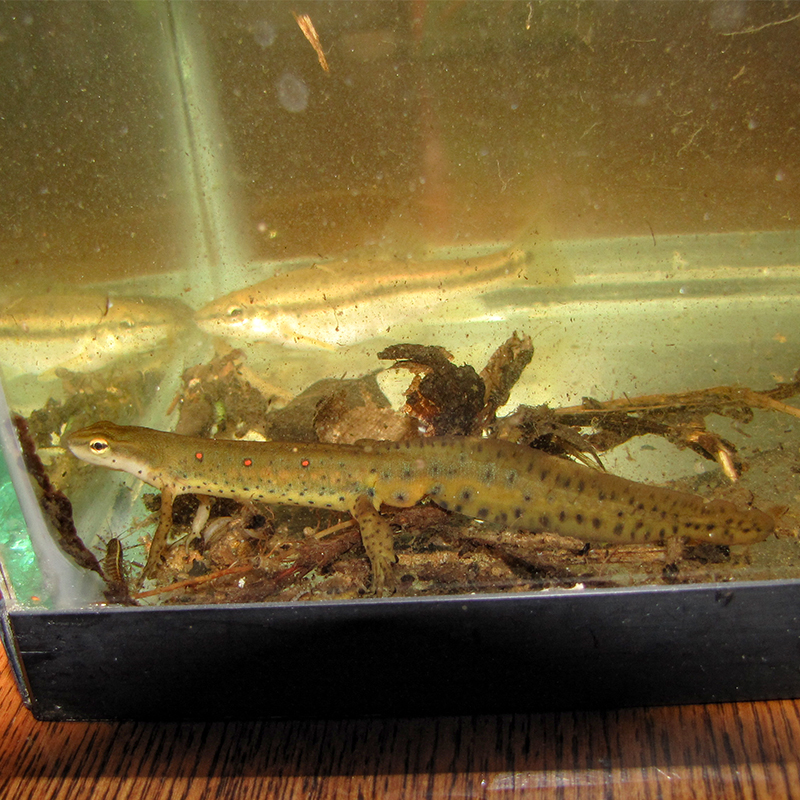
colour photo of a newt in the corner of an aquarium

Red-spotted Newt

Kingdom: Animalia

Phylum: Chordata 

Class: Amphibia

Order: Urodela

Family: Salamandridae

Genus: Notophthalmus

Species: Notophthalmus viridescens

The Red-spotted Newt is an interesting amphibian because it has a bonus life stage in its life cycle. It starts off as an egg that hatches into an aquatic larva typical of amphibians. But, uniquely, this larva turns into a terrestrial juvenile called a Red Eft before maturing into an aquatic adult! Red Efts have slightly rough dry skin and are bright orange or red, with dark red spots outlined in black. In their adult stage, they turn more of a dull green, but they keep those red spots outlined in black. That’s because these spots are important for warning predators away! The Red-spotted Newt has toxins in its skin that make it a poor choice for prey and it wants all the other animals around to know it!


 

Page category: 
Insects, Mammals, and More [1]

Information

  • Contact
  • Google Maps
  • E-newsletter
  • Registration Info
  • Publications

Connect With Us

  • Volunteer
  • Plan Your Trip
  • Meet the Staff
  • FAQ
  • Donate
  • OAC

OAC Centennial Arboretum Centre
250 Arboretum Road
Guelph, ON N1G 2W1
arbor@uoguelph.ca
(519) 824-4120 ext. 52113

BGCI logo ArbNet logo

The land where The Arboretum now grows has been home to plants and animals for thousands of years. It was home to Indigenous peoples long before settlers arrived. We recognize the traditional, ancestral, and treaty lands of the Anishinaabeg, Haudenosaunee, Attawandaron, and Mississaugas of the Credit peoples, as well as the Dish with One Spoon covenant covering the Between the Lakes Treaty 3 lands on which the University of Guelph and The Arboretum now sit. We are honoured to work on and care for this land.


Source URL:https://arboretum.uoguelph.ca/red-spotted-newt

Links
[1] https://arboretum.uoguelph.ca/page-category/insects-mammals-and-more