eastern white cedar / Thuja occidentalis
Also known as northern white cedar, this common conifer is easily recognizable by its scale-like yellow-green leaves. This versatile tree is often found growing in “stressful” places quite happily – in fact, the Niagara escarpment is home to eastern North-America’s oldest forests, with cliff-dwelling white cedars that are over 1500 years old! The seeds are important food for many winter finches, and provide cover for white-tailed deer.
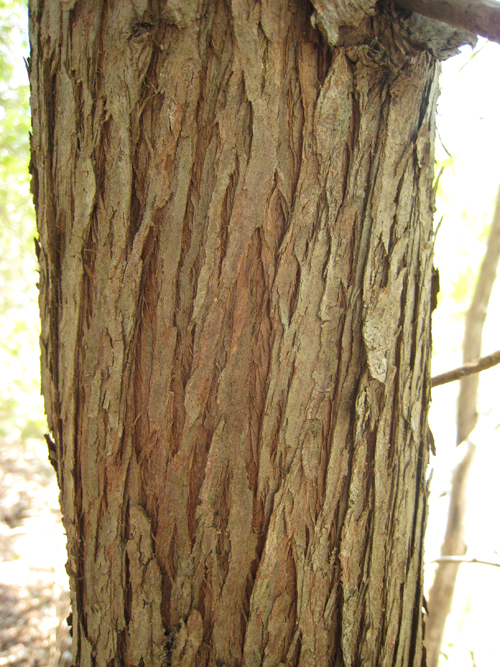
The fragrant, grayish bark forms narrow strips, and was historically boiled with the needles into a tea to prevent scurvy. This technique saved the lives of many scurvy-riddled French explorers, giving rise to the name “tree of life”. Photo by Brian Lacey.
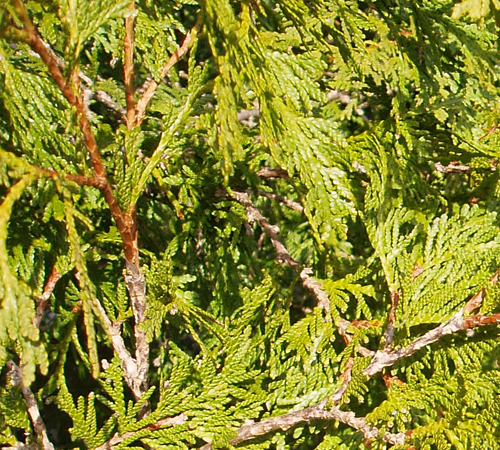
The flat scaled leaves of the eastern white cedar. Photo by Chris Earley.
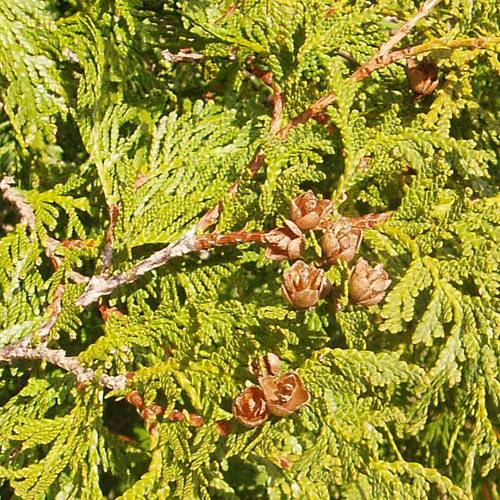
These very small cones are produced in the spring and drop their seeds in the fall. Photo by Chris Earley.
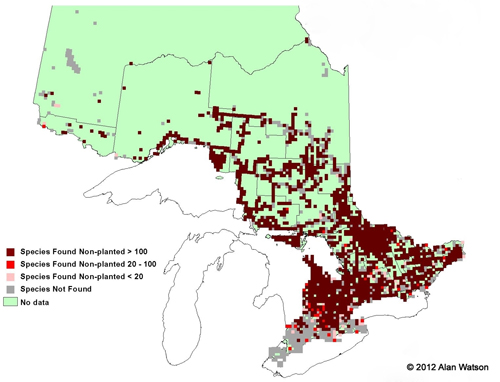
Ontario Tree Atlas map of non-planted Northern White Cedar. 1995-1999.
Return to tree listings page [1]
References
Farrar, J.L.. 1995. Trees in Canada. Fitzhenry & Whiteside Ltd. Toronto. ON. 504 pp.
Kershaw, L. 2001. Trees in Ontario: Including tall shrubs. Lone Pine Publishing. Edmonton. AB. 240 pp
Muma, W. 2011. Ontario Trees and Shrubs. [Online] Available: www.ontariotrees.com
OMNR, 2011. Ontario Ministry of Natural Resources: Ontario Tree Atlas. [Online] Available: http://www.mnr.gov.on.ca/en/Business/ClimateChange/2ColumnSubPage/267027.html
OMNR, 2008. Ontario’s Biodiversity: Species at Risk.